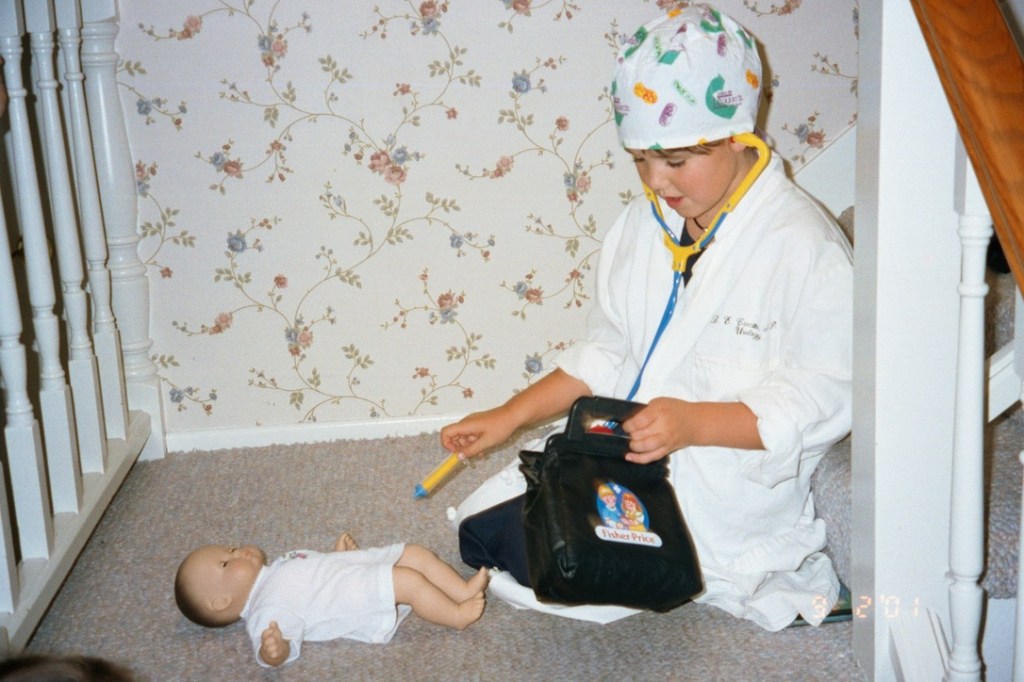
What They Never Told Me About Surgery and Womanhood
When My Daughter Asked the Question That Broke Me
One morning, as I was racing to get everyone out the door, my eldest daughter—maybe 7 or 8 at the time—stopped me.
She looked up with a serious face and asked,
“Mom, is there such a thing as a mom who is just… a mom?”
I froze. I wanted to say “No.” But of course I understood what she meant.
She wanted the kind of mom who picked her up from school, who came to classroom parties, who baked cookies and stayed for lunch. She wanted a mom like most of her friends had.
Not a mom rushing in late from the hospital, still wearing scrubs under her coat, juggling patient calls while helping with homework.
Her question landed like a stone in my gut.
I wasn’t enough—not at home, and not at work either. That’s how it felt.
The Fellowship That Asked Me to Wait
When I was selected to become his Fellow, I was proud. He usually only took one Fellow a year, and it was considered prestigious.
But that year, he had selected two—me, and a male peer.
Normally, the Fellowship was two years: one research, one clinical.
But for me, it would be three.
Why? Because I was a woman.
He said it openly:
“You’ll need to do an extra year in the lab so your male co-fellow can finish training and go earn money to support his family.”
I sat there stunned.
So I didn’t have financial needs?
Or mine came second because I was a woman?
I had a husband in training. A young child. Another on the way. And yet, my professional advancement was delayed—rationalized away in the name of someone else’s responsibilities.
It was a clear message: his needs mattered more.
The Conversation I’ll Never Forget
I remember sitting in my Chair’s office at the end of my training—nine years under his leadership, nine years of striving. I held him in high regard, even awe. He was the kind of surgeon who made the OR look like a stage. Every move he made was deliberate, elegant. He seemed to dance through the anatomy, navigating even complex operations with ease and clarity.
I wanted to be like him—precise, unshakable, masterful.
But mostly, I wanted to hear him say I was good.
That I had good hands.
That I was a great surgeon.
It never came.
In surgery, excellence was expected, not praised. Mistakes, however, were always highlighted. So I kept pushing harder. Every critique became fuel. Every success I downplayed, waiting for that elusive validation that never arrived.
He played golf and basketball with the other male residents. They had long talks in locker rooms, banter over weekend tournaments. I didn’t fit into those spaces. I didn’t play those sports. I had a baby at home. Another on the way. My free time wasn’t spent networking—I was pumping milk, changing diapers, managing on-call schedules while managing colic.
So when we finally sat down to discuss my future, it felt like a rare moment of mentorship.
I don’t remember everything we talked about that day. But I remember his final words, as clearly as the smell of betadine in an OR.
“Laura, you need to take a job where you can be a mom.”
I froze.
What did that mean?
Did he tell the men: “Take a job where you can be a dad”?
What kind of job, exactly, allows one to “be a mom”?
And more hauntingly: What kind of job doesn’t?
What opportunities was I now disqualified from?
I left that conversation feeling smaller than I had in years.
Not because I was unqualified. But because I was seen as something less—less ambitious, less capable—simply because I was a mother.
The Weight of Being Different
Years later, I interviewed for a position at a top-tier institution. One of the physicians—a fellow urologist—had called my former Chair before our meeting. He wanted to know: Would I be a good fit for his organization?
After the interview, he said something that struck me.
“You know, people here work hard.”
There it was again. The assumption: that because I had children, I couldn’t possibly work hard enough.
Even years later—long after diapers, long after daycare—I was still confined by the label of being a mom. My children were mostly grown. I had decades of experience. Yet that old narrative persisted, silently shaping the decisions of others.
They had spoken. The decision had been made, somewhere behind closed doors.
I wasn’t a surgeon who happened to be a mother.
I was a mother who had wandered into surgery.
What They Never Told Us
This is what it means to be a woman in a surgical field.
Despite comprising over 50% of medical school graduates, women remain significantly underrepresented in most surgical subspecialties. In urology, women account for just 10% of practicing urologists.
The message is clear: it’s not that women are less capable.
It’s that medicine—especially surgery—is still built around male life patterns and male career arcs.
Working hard doesn’t mean skipping every family dinner, or powering through illness, or operating 9 months pregnant. It means showing up, again and again, in a system that wasn’t built for you—and still doing your job with excellence.
To the Women Coming After Me
To every young woman in surgery who’s been told to “take a job where you can be a mom,” I see you.
To the ones who hide in bathrooms to pump.
To the ones who take call while holding a toddler’s hand.
To the ones who wonder if it’s worth it.
You are already doing two of the hardest jobs in the world.
And you are enough.
 Finding My Rhythm: Healing, Leading, Becoming
Leave a comment